Christina Lorenzatto Receives Grant from the Alfonso Ortiz Center for Intercultural Studies
Departmental News
Posted: Oct 27, 2026 - 12:00pm
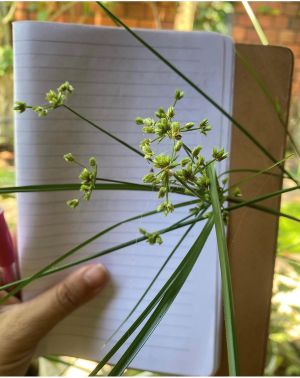
Christina Lorenzatto, doctoral candidate in Sociocultural and Linguistic Anthropology (SCALA), has received a grant from the Alfonso Ortiz Center for Intercultural Studies to support her project Cultivating Knowledge: A Collaborative Piri-Piri Garden for Shipibo-Konibo Botanical Preservation.
Project Abstract
This project establishes a collaborative Piri-Piri (Cyperus spp.) garden with Asociación Intercultural Moatiabi Noi-Ananti Xobo in a peri-urban settlement near Pucallpa, Peru, creating a living repository where Shipibo-Konibo women can cultivate threatened plant varieties, transmit botanical knowledge across generations, and document their sophisticated classification systems (Daly and Shepard 2019). This second garden site complements a rural garden already funded by a Wenner-Gren Foundation Dissertation Fieldwork Grant at the Jakon Rate organization. While the Wenner-Gren grant supports the researcher's fieldwork expenses, international travel, equipment, and the establishment of the first garden at Jakon Rate in a rural setting, Ortiz Center funds are directed exclusively toward the peri-urban garden site at Moatiabi Noi-Ananti Xobo—a site that serves distinct research and community purposes not covered by external funding.
The two-garden design is central to the research methodology of Christina's doctoral dissertation, What Kind of People are Piri-Piri Plants?: Life Histories, Sensory Ecologies and Moral Agency Among the Shipibo-Konibo Women of Peru. The dissertation's core comparative framework examines how Piri-Piri knowledge, cultivation, and classification practices are being transformed across three Shipibo-Konibo settlement types: remote forest, peri-urban, and urban. A single garden at the rural Jakon Rate site cannot capture this variation. The peri-urban garden at Moatiabi Noi-Ananti Xobo addresses precisely the context where Piri-Piri knowledge is under the greatest pressure—where market integration, wage labor, reduced land access, and distance from forest are actively transforming women's relationships with plants. Drawing on Hornborg's (2001) ecosemiotic framework, the peri-urban site is where the shift from direct, sensory, face-to-face engagement with plants to increasingly mediated relationships with plant varieties is most visible and consequential.
Furthermore, the two gardens create complementary nodes in the plant circulation networks that are central to Shipibo-Konibo botanical practice. Women, plants, and knowledge circulate continuously between settlements—elders bring Piri-Piri cuttings to daughters in peri-urban areas, urban women return to rural communities to diet with plant teachers, and varieties move through kinship networks in both directions. Two gardens in ecologically and socially distinct settings allow systematic documentation of how the same varieties are named, classified, and used differently depending on settlement context. When women from both sites view the same numbered specimens, the resulting pile-sort and classification data reveal how ecological context shapes botanical knowledge—data that a single-site design cannot produce.